

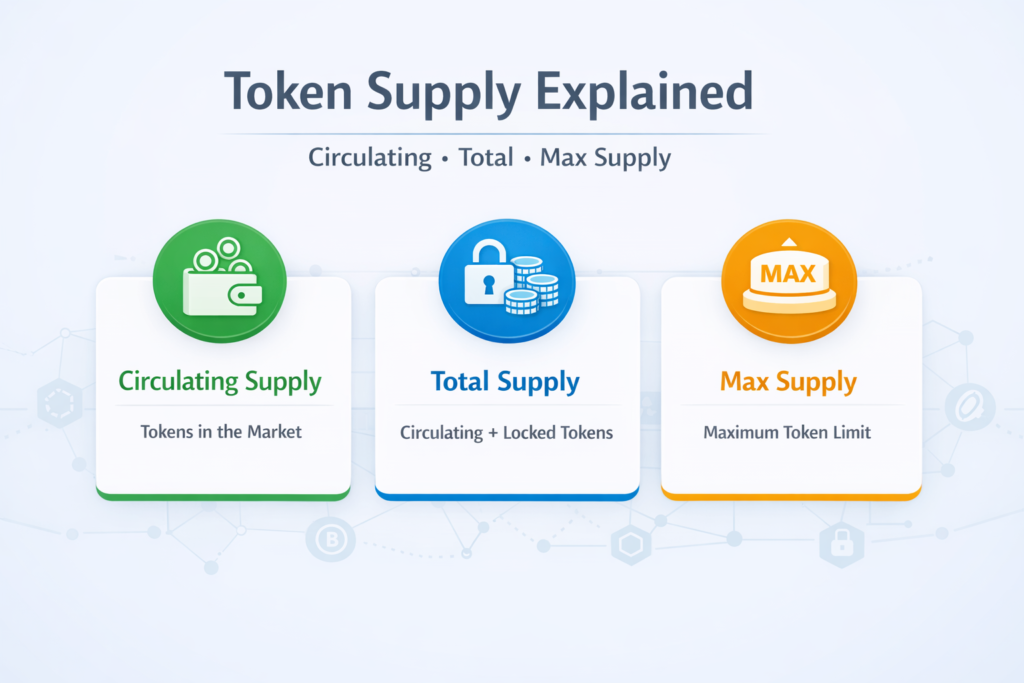
Token Supply Explained: Circulating Supply, Total Supply & Max Supply
Understanding token supply is one of the most important parts of tokenomics. Whether you’re learning about cryptocurrencies, evaluating a project, or trying to understand price movement, token supply plays a major role in how a token is valued.
In this beginner-friendly guide, we’ll explain token supply in simple terms and break down the difference between circulating supply, total supply, and maximum supply — and why they matter in crypto.
 What Does Token Supply Mean?
Token supply refers to the number of tokens that exist for a cryptocurrency project — including how many are currently in circulation, how many are locked or reserved, and how many may exist in the future.
In simple words, token supply answers questions like:
How many tokens exist right now?
How many tokens will ever exist?
Are tokens locked, vested, or burned?
Can more tokens be created later?
Token supply has a direct impact on:
scarcity
token price
inflation or deflation
investor confidence
long-term sustainability
This is why token supply is a core part of tokenomics.
(If you’re new to tokenomics, you may also like our guide on Tokenomics Explained.)
 Why Token Supply Matters in Cryptocurrency
Two cryptocurrency projects can have the same price — but completely different token supplies — meaning their market value and scarcity are not equal.
For example:
A token with 1 billion supply is very different from
A token with 21 million supply
Even if their price per token looks similar, their total value and scarcity are not.
Token supply helps users understand:
whether a token is scarce or inflationary
how new tokens enter circulation
whether early holders control a large percentage
whether supply unlocks may affect price
the long-term sustainability of the project
In short — supply influences value, trust, and token behavior over time.
 Types of Token Supply in Crypto
Token supply is usually divided into three key metrics:
Circulating Supply
Total Supply
Maximum (Max) Supply
Let’s understand them one-by-one.
 What Is Circulating Supply?
Circulating supply refers to the number of tokens that are currently available in the market and actively in circulation.
These tokens can:
be bought or sold
be traded on exchanges
exist in user wallets
Circulating supply does NOT include:
locked tokens
vested tokens
team reserves
non-released tokens
It only includes tokens that are available right now.
 Why circulating supply matters
Token price is usually determined based on:
This means:
if circulating supply increases → price may drop
if supply decreases (burning) → price may stabilize or rise
Projects with large supply unlocks can face selling pressure if tokens are released too quickly.
 What Is Total Supply?
Total supply includes:
circulating tokens
PLUSlocked or reserved tokens that already exist
It does not include future tokens that may be minted later.
In simple words:
Total supply = Tokens created so far (circulating + locked)
Examples of locked tokens in total supply:
team tokens under vesting
tokens reserved for staking rewards
foundation or treasury tokens
ecosystem development reserves
Why total supply matters
It shows:
how much supply may enter market in future
whether a few wallets control large amounts
overall token distribution risk
If a large amount of locked tokens will unlock later, it can impact price and market confidence.
 What Is Maximum Supply?
Maximum supply (max supply) is the highest number of tokens that can ever exist for a project.
After this limit is reached — no more tokens can be created.
Example:
Bitcoin max supply = 21 million
No more Bitcoin can ever be created
However…
Not all cryptocurrencies have a max supply.
Some tokens have:
no fixed supply limit
inflationary minting models
Why maximum supply matters
Max supply helps users understand:
scarcity vs unlimited supply
long-term inflation risk
whether the token becomes more scarce over time
Tokens with a fixed supply are often seen as more deflationary — but design depends on project goals.
 Circulating vs Total vs Max Supply — Quick Comparison
| Supply Type | Includes | Excludes | Meaning |
|---|---|---|---|
| Circulating Supply | Tokens currently in the market | Locked & vested tokens | Actively tradable supply |
| Total Supply | Circulating + locked tokens that exist | Future minting | All existing tokens |
| Maximum Supply | Absolute cap of tokens possible | — | Final supply limit |
Understanding the difference helps you evaluate a crypto project more accurately.
 How Token Locks & Vesting Affect Supply
Many projects lock certain tokens to avoid dumping, such as:
team tokens
investor allocations
advisor tokens
foundation reserves
Locked tokens are not part of circulating supply — but they may unlock later through vesting schedules.
Unlocking tokens can affect:
selling pressure
market confidence
token price stability
Well-planned vesting models help avoid sudden supply shocks.
 Token Burning & Deflationary Supply
Some cryptocurrencies reduce supply through token burning, meaning tokens are permanently removed from circulation.
Burning may:
reduce circulating supply
reduce inflation
increase scarcity
However — burning alone does not guarantee price increase.
It depends on:
demand
utility
adoption
project fundamentals
Burning is one part of tokenomics — not the only factor.
How Token Supply Affects Tokenomics
Token supply is deeply connected to:
token distribution
staking rewards
emission schedules
governance allocation
ecosystem incentives
Strong tokenomics ensure:
fair distribution
balanced supply release
sustainable long-term ecosystem growth
Weak tokenomics can lead to:
high inflation
centralized ownership
rapid price crashes
This is why understanding token supply is essential for beginners.
 How Beginners Should Evaluate Token Supply
When learning about a project, try to check:
 Circulating supply Total supply Maximum supply Locked vs vested tokens Supply release schedule Token utility & use-cases
Avoid assumptions based only on token price.
Supply context matters much more.
 Final Thoughts
Token supply is one of the most important elements of tokenomics. It affects scarcity, distribution, price behavior, and long-term sustainability of a cryptocurrency project.
By understanding circulating supply, total supply, and maximum supply, beginners can interpret token metrics more accurately and develop a clearer understanding of how cryptocurrency ecosystems work.
This guide is part of our Tokenomics education series, where we explain crypto tokens, token distribution, supply models, and economic design principles used in blockchain projects.